
Better Global Future · Module 3 of 5
Module 3: Cooperation
Notice how much of your life depends on cooperation, and ask what, and whom, you are really cooperating with.
Every meal you eat, every piece of clothing and every device you use depends on the work of many people you will never meet. Cooperation is how humans have survived, and it runs through daily life, mostly without our noticing.
This module asks you to look at that cooperation more consciously. Who and what do your money, time and attention support? Do those choices serve everyone, or only a few? And what would it take to shift your focus from "me" to "we"?
Your worksheets for this module ↓
Three short worksheets go with the eight steps. Print them, fill them in on screen, or keep a notebook beside you.
In this module you will
- Explore your own feelings about cooperation, including what draws you to it and what makes you hold back.
- Recognise how much everyday cooperation happens without a conscious choice.
- Consider whether your choices support the wellbeing of all or work against it.
- Commit to making one choice more consciously.
What you can take away
- A sharper awareness of the systems you take part in through what you buy, use and accept.
- Words for the tension between cooperating and simply complying, and permission to say no.
- One practical change in where you put your resources or energy.
Your worksheets
Read each worksheet online first; download the fillable PDF only if you want your own copy. Your answers stay with you.
Reflect
Step 1: Your initial thoughts
Listen
Step 2: Hear what others think
Three participants share their first thoughts: cooperation as an expression of our humanity, a longing for more of it in systems that rarely encourage it, solidarity across borders, and an honest ambivalence about the pressure to fit in with a group.
Challenge
Step 3: Challenge your thinking
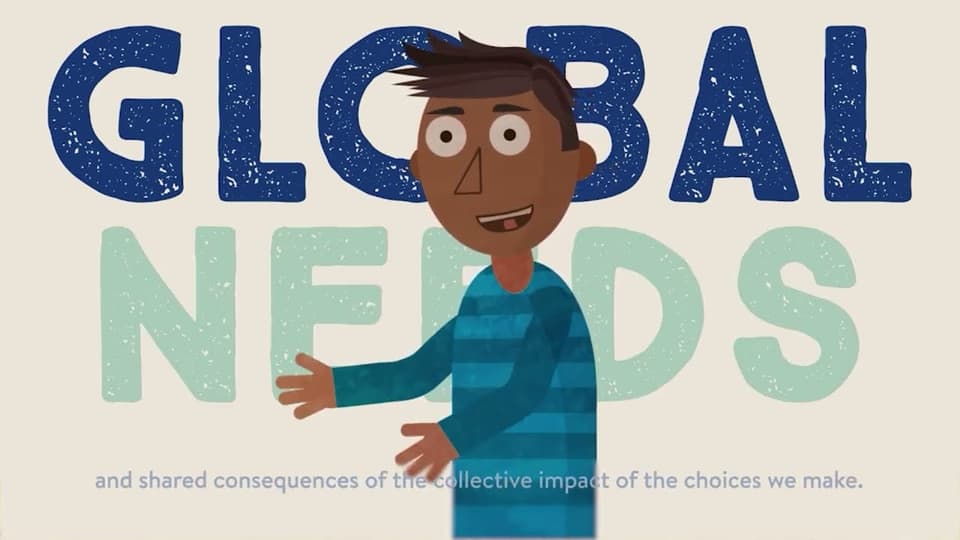
The film traces cooperation from the earliest human groups to today's global society. It asks you to look at the hidden cooperation behind your daily life, such as your last meal, your clothes and the device you are using now, and at the choices you make about what you buy, which media you follow and which social norms you accept.
Its challenge is pointed. If we do not make active, conscious choices, we may be cooperating with forces that harm us all, and being part of the solution may cost us some personal convenience.
React
Step 4: Your reaction
Listen
Step 5: Explore the reactions of others
Participants respond: be deliberate about who you cooperate with and why; take heart from how much cooperation already exists; remember that the urgency is not felt equally by everyone; and face up to an economic system that brings both prosperity and harm.
Reflect
Step 6: Your AHA moment
Listen
Step 7: Hear the AHA of others

Commit
Step 8: Let's do something!
Go further
Suggested activities
Optional tasks to deepen your thinking after the eight steps. Pick one that suits you; there is space for it at the end of the worksheet.
The story behind one object
20 minutes
Pick something you use every day: a phone, a T-shirt, a cup of coffee. Map as many of the people, places and resources involved in getting it to you as you can. Who benefits along the way? Who might be harmed?
Your "yes" list
15 minutes
List five things you regularly give money, time or attention to. For each, ask: what am I cooperating with here? Would I choose it again if I were choosing consciously?
From me to we
15 minutes
Think of a group you belong to, such as your family, a team or a community. Where does it cooperate well, and where does self-interest get in the way? What is one thing you could do to strengthen the "we"?
Coming next. Module 4 asks what it means to take responsibility for the future, and what kind of ancestor you want to be.
The films were first published on YouTube between December 2022 and January 2023. Where they quote statistics, these reflect the data available at the time. Videos play in YouTube's privacy-enhanced mode, and nothing is loaded from YouTube until you press play.