
Better Global Future · Module 1 of 5
Module 1: Evolving
Look at the long story of how humanity has developed, and ask what kind of next chapter you want to help write.
Humans have been changing their world, and being changed by it, for millions of years. In this module you step back and look at that long story: where we have come from, what our progress has cost, and where we might be heading.
There is no correct view to arrive at. The films give you one telling of the story and other people's responses to it. Your task is to notice your own reaction, test it against other perspectives, and decide what it means for the way you want to live.
Your worksheets for this module ↓
Three short worksheets go with the eight steps. Print them, fill them in on screen, or keep a notebook beside you.
In this module you will
- Reflect on what you already believe about human progress, and where those beliefs come from.
- Follow a short history of humanity, from the first tools to the Sustainable Development Goals, including the injustices that came with it.
- Hear how people in different countries see the same story.
- Decide on one small, concrete commitment.
What you can take away
- A clearer sense of the story you tell yourself about humanity's past and future.
- The insight that the same history can be told hopefully or critically, and that every telling leaves something out.
- A first commitment to act on, and notes to build on in the later modules.
Your worksheets
Read each worksheet online first; download the fillable PDF only if you want your own copy. Your answers stay with you.
Reflect
Step 1: Your initial thoughts
Listen
Step 2: Hear what others think
Now listen to how people in other parts of the world answered the same questions. Listen out especially for a view that differs from yours: it is often the most useful one.
The second, shorter clip adds one more perspective: the idea that humanity has reached another of its great turning points.
Challenge
Step 3: Challenge your thinking
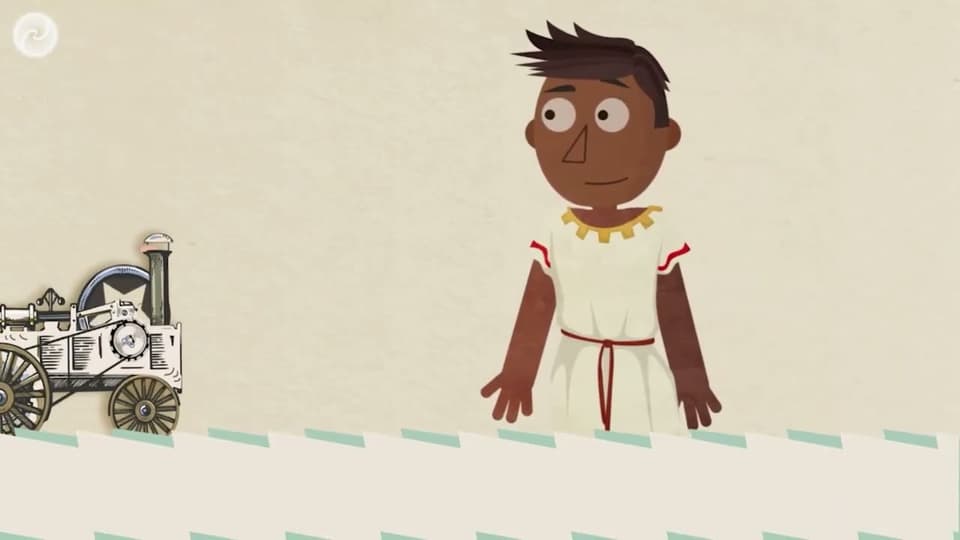
This is the core film of the module. In a few minutes it moves from the first humans, through farming, cities and empires and the scientific and industrial revolutions, to the first photographs of Earth from space and the global challenges of today. Watch it to the end.
The film tells history as a long effort to build a better future, but it does not hide the violence, exploitation and injustice along the way. Pay attention to how the story is told as well as what it says, and notice how it makes you feel.
It ends by handing the questions back to you: is a fairer way of developing together possible, is it the right goal, and where do you stand?
React
Step 4: Your reaction
Listen
Step 5: Explore the reactions of others
Three participants respond to the film. One notices that the way we tell history is itself a choice. Another brings the view of a doctor working with people who cannot afford care. A third describes starting with their own wellbeing and widening the circle from there.
Reflect
Step 6: Your AHA moment
Listen
Step 7: Hear the AHA of others
Finally, hear what others took away. One speaker pictures a future that builds on technology and global connection instead of retreating from them. Another asks a question worth keeping: is what seems positive to me also positive for the people around me?
Commit
Step 8: Let's do something!
Go further
Suggested activities
Optional tasks to deepen your thinking after the eight steps. Pick one that suits you; there is space for it at the end of the worksheet.
Two tellings of history
20 minutes
Write five sentences that sum up human history as the film tells it. Then rewrite them from the point of view of a group the film mentions only briefly or not at all: colonised peoples, women, workers, or the natural world. What changes? Which telling feels closer to the truth?
Three generations
15 minutes
Sketch a simple timeline for your grandparents, your parents and yourself. What changed for each generation, and what did each have to adapt to? What might the next generation need from yours?
Ask someone else
15 minutes
Ask someone outside your usual circle the module's opening question: how has humanity evolved, and what comes next? Write down their answer and how it differs from yours.
Coming next. Module 2 looks at how varied the human family really is, and what we can learn from people whose lives are unlike our own.
The films were first published on YouTube between December 2022 and January 2023. Where they quote statistics, these reflect the data available at the time. Videos play in YouTube's privacy-enhanced mode, and nothing is loaded from YouTube until you press play.